How to Generate Sine Waves Using Space Vector Modulation
Space Vector Algorithm Step-by-Step
Get Your Project Done Faster!
Using the Space Vector Handbook, you can program Space Vector in a microcontroller starting from scratch using only basic technical skills.

which produce 3-phase sine wave output.
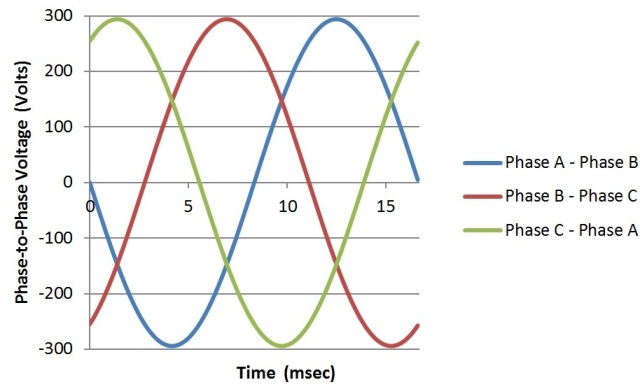
The Space Vector Handbook shows this process step-by-step.
You can generate 3-phase from a DC voltage by directly generating 3 sine waves that are phase-shifted 120 degrees with respect to each other (that is 1/3 of a cycle with respect to each other) from a DC voltage without using Space Vector Modulation.
But Space Vector Modulation is a better way to generate 3-phase because it creates 3-phase sine waves with about 15% higher amplitude for a given DC input voltage, and this will result in about 15% greater top speed potential when driving a motor, and over 30% more power output capability for the same DC input voltage.
This handbook was written because most "white papers" and "application notes" on Space Vector Modulation just "throw" at the reader the usual poorly-explained Space Vector Hexagon diagram followed by complex sets of equations with little or no clear explanation and no practical implementation instructions; also, many of these publications have omissions, errors, and typos which make them of little practical value.
Unlike these typical "application notes" and "white papers" on Space Vector Modulation, the Space Vector Handbook will not burden you with complex mathematical derivations and confusing diagrams. Just follow the step-by-step instructions in this handbook to implement Space Vector for your application.
"Application notes" typically show C code or assembly language to produce Space Vector Modulation just for a specific microcontroller, without an easy-to-understand, clear explanation of how the code generates the Space Vector Modulation output, so you're limited to using that particular microcontroller; worse yet, this code is usually "bundled" with other features (various "bells & whistles", sensors, etc.) that you may not need or want in your application, and which can be difficult and time-consuming to remove from the code.
Unlike "application notes" and "white papers," the Space Vector Handbook shows you with clear step-by-step instructions what your microcontroller or digital signal processor (DSP) needs to do to implement Space Vector instead of giving long code listings for a particular microcontroller. Following the step-by-step instructions, flow diagrams, and generic pseudocode in the Space Vector Handbook, you write the specific code (in C, C++, assembly language, etc.) for your particular microcontroller.
In addition, an Appendix is included in the Space Vector Handbook which gives a practical explanation of Space Vector Theory, including a clear explanation of the function and use of the Space Vector Hexagon. To simplify understanding, the spinning of the Space Vector around the Space Vector Hexagon is compared to the spinning of the second hand around the face of an analog clock.
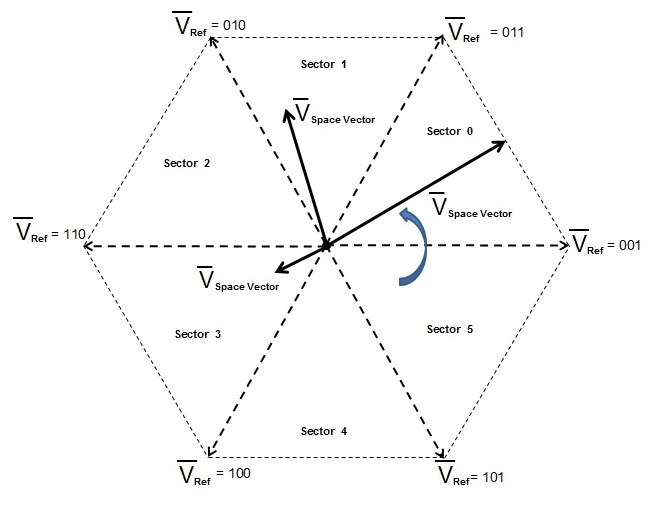
Although knowing the theory in the Appendix is not necessary to follow the step-by-step instructions in the Space Vector Handbook, if you want to learn Space Vector theory, the Appendix provides a practical explanation of the theory. The Appendix is written to be understandable to anyone who knows basic geometry, trigonometry, and algebra.

The Space Vector algorithm is embedded in the spreadsheet cells, which take angle or time input from the left side of the spreadsheet, and output the Space Vector Modulation sine wave values to the right side of the spreadsheet. Plots of the sine wave outputs are also included in the spreadsheet. This Space Vector Handbook can be used without the included spreadsheet, but the spreadsheet is an extra tool that provides a quick, low-cost way to observe Space Vector function in action without implementing Space Vector on an actual inverter microcontroller.
With clear step-by-step instructions, flow diagrams, and pseudocode, the Space Vector Handbook will give you a practical understanding of how to implement Space Vector Modulation. The Space Vector spreadsheet provides additional insight on the "mechanics" of Space Vector Modulation. The Space Vector theory Appendix gives a clear and practical explanation of Space Vector theory. The Space Vector Handbook is powerful and generic, applicable to a wide range of applications.
80 pages, 15000+ words, 23 Figures.
(Includes both the Space Vector Handbook E-Copy and Excel Space Vector Simulation Spreadsheet)
$69.95

Billed as QUARVIK · Secure checkout by Stripe
-

- Copyright ©2015 78Systems, LLC.
- Questions, Comments, Suggestions ?